


Every few months someone declares the end of software. And every few months I see more software being built than the month before. The real change is in who is building it.
In the last year I’ve watched three people in my life become software builders, and none of them is a developer. A real estate agent I know got tired of bending her business around a generic CRM, so she built her own. My brother-in-law is a doctor, and he built a learning app for his team. My personal trainer built a tool to plan his clients’ workouts. None of them hired an agency, learned React or asked me for help, which as a CTO I find both delightful and slightly insulting.
This isn’t the end of software. It’s the age of personalized software.
Building software got absurdly cheap
The numbers are hard to argue with. Lovable launched in November 2024 and crossed $600 million in annualized revenue in September 2026. Its co-founder says apps built on the platform now get close to a billion visits a month. By June, users had created more than 50 million projects and were adding a million new ones every week. Cursor went from about $100 million in annualized revenue in January 2025 to $2 billion by February 2026. Replit raised $400 million at a $9 billion valuation in March 2026.
The more important number is who these users are. Lovable’s build economy report surveyed more than 14,300 users and found that 80% describe themselves as non-technical. Nearly two-thirds work outside tech, in education, retail, finance, healthcare and real estate. And they aren’t building toys. They’re building websites, internal tools, CRMs, inventory systems and HR platforms, the software businesses actually run on. My realtor friend is a data point, not an outlier.
The cost of entry has collapsed too. Cursor’s Pro plan costs $20 a month. Replit’s CEO shared a message from a doctor with no coding experience who built a clinic app in five days, with bookings, prescription requests and medication tracking, for about £75. He estimated the same thing would have taken one to two years and £100,000 to £150,000 through traditional development. That’s one user’s own claim, not an audited case study. But the shape of it matches what I see around me.
Andrej Karpathy saw this coming. In early 2023 he joked that the hottest new programming language is English. Two years later he gave the practice a name, vibe coding: you give in to the vibes and forget the code even exists. He has since called it a throwaway tweet. It stuck because millions of people recognized what they were already doing.
Software for one
This idea isn’t new. It just finally got cheap.
In 2004, Clay Shirky described what he called situated software: software designed for a specific group of people rather than for generic users, deliberately rejecting scale and completeness as automatic virtues. In 2020, the novelist Robin Sloan built a messaging app with exactly four users, all of them his family. He described himself as the programming equivalent of a home cook, and argued that once you free programming from the need to be professional and scalable, it becomes a different activity altogether, the way cooking at home has little in common with a restaurant kitchen.
Back then, home-cooked software was for people who could already code. Now it’s for anyone who can describe what they want. My trainer doesn’t need a fitness SaaS built for ten million users. He needs something that fits the way he coaches. For the first time, building that is cheaper than putting up with a tool that almost fits.
We’ve seen this movie before
Every time a creative tool got commoditized, incumbents predicted the death of their profession. Every time, the market exploded instead.
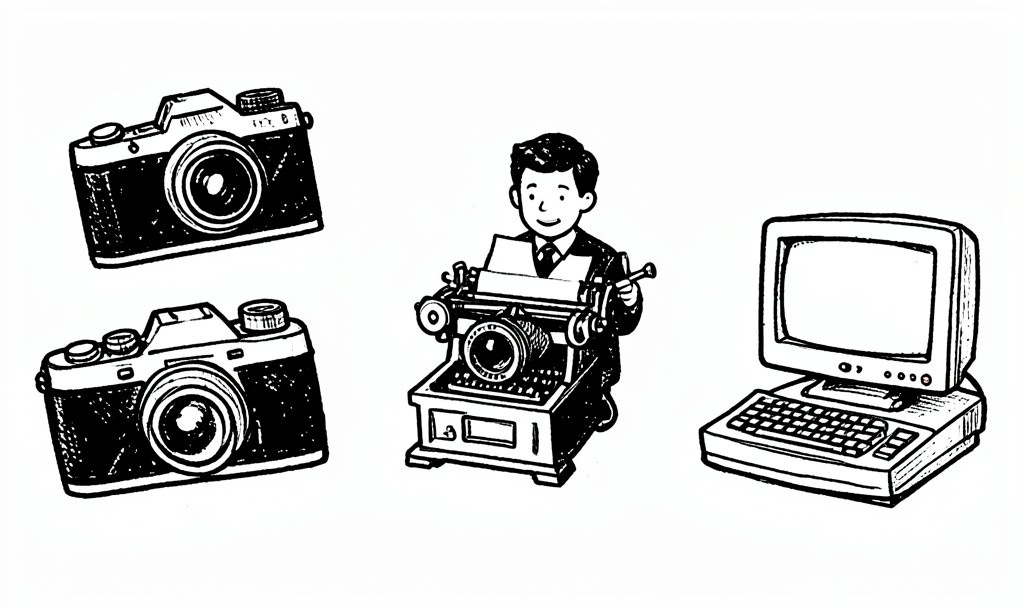
Photography. Kodak’s first camera in 1888 cost $25, sold on the promise that you press the button and Kodak does the rest. In 1900 the Brownie cut the price to $1, with film at 15 cents a roll, and sold 100,000 units in its first year. Photography went from a technical craft to a family hobby. Today humanity takes an estimated 2.1 trillion photos a year, most of them on smartphones. Professional photographers didn’t disappear. They moved to weddings, commercial work and art, where taste and trust matter more than owning the equipment.
Spreadsheets. VisiCalc shipped for the Apple II in 1979 at about $100, and people bought a $2,000 computer just to run it. Managers and analysts became end-user programmers overnight, and accountants were supposed to be finished. Instead, according to NPR’s Planet Money, about 400,000 bookkeeping and accounting-clerk jobs have disappeared since 1980 while 600,000 accountant jobs have been added. Cheap calculation made people want more analysis, not less.
Desktop publishing. In 1985 Apple shipped the LaserWriter and Aldus shipped PageMaker, and Aldus founder Paul Brainerd coined the term desktop publishing. Newsletters, church bulletins and community papers that once needed a professional typesetter could now be made by one person at a desk. Designers didn’t vanish. The volume of designed material exploded, and a new professional tier grew on top of it.
The web and music. WordPress now runs about 40% of all websites. Anyone can publish. In music, an average of 106,000 new tracks reached streaming services every day in 2025, and the figure is now closer to 150,000. The sobering part: the vast majority of those tracks barely get played. When creation gets cheap, the long tail gets enormous. Most of it is personal, and that’s fine.
Economists call the underlying pattern the Jevons paradox. In 1865 William Stanley Jevons noticed that more efficient steam engines led to more coal being burned, not less. When something gets cheaper, demand often grows faster than the savings. Software demand looks extremely elastic. There’s a whole universe of software that was never worth building at £150,000 and is clearly worth building at £75.
So is SaaS dead?
Wall Street certainly panicked. In early February 2026, disappointing earnings combined with a wave of new agentic AI tools set off what traders called the SaaSpocalypse. Forbes reported that software stocks had lost more than 20% of their value that year, wiping out around $1 trillion in market value while the S&P 500 stayed flat.
Then the story got more complicated. By June, software stocks had rebounded about 13%, and private equity investors like Thoma Bravo’s Orlando Bravo were calling AI a tailwind for software companies.
Klarna is the cautionary tale for anyone predicting mass SaaS replacement. In 2024 its CEO told investors the company was shutting down Salesforce and Workday. The headlines said Klarna had replaced SaaS with AI. What actually happened was a consolidation of its data into a graph database, internal interfaces built with AI coding tools, and HR moved to another SaaS vendor. The CEO later said he was embarrassed by how the story spread, and that he doubts most companies will follow his lead.
My take: the moat that’s falling apart is features. The moats that hold are everything around them. Single-purpose SaaS tools that own neither the workflow, the transaction nor the data are easy to replicate with vibe coding, and they’re in real trouble. Systems of record, regulated workflows, network effects and distribution are a different story.
Then there’s maintenance. As one enterprise CTO put it, vibe coding a first version is only a down payment on a long-term commitment, and that commitment is the real reason software vendors exist. Building the first version is easy. Keeping it running is the hard part.
Security is the other bill that comes due. In 2025, researchers found that 170 of 1,645 apps showcased on Lovable were exposing user data through missing database access rules. In 2026, a scan of 380,000 publicly accessible assets built with popular AI app builders found around 5,000 apps exposing sensitive data, including medical and financial records. My brother-in-law’s learning app is low-stakes. A clinic app holding patient records is not. Shadow IT used to mean an unapproved spreadsheet. Now it can mean an unapproved app with a public database.
Where the value moves
When building is cheap, value shifts to whatever is still scarce. Here’s where I’d put my chips as a founder:
Build the kitchen, not the meal. The biggest winners of the Brownie era were the film and processing businesses, not the camera makers. The equivalent today is the infrastructure for personal software: auth, hosting, databases with safe defaults, payments, connectors, security scanning and painless maintenance.
Own the data and the workflow, not just the interface. If your product is a nice UI over a table, a realtor can rebuild it over a weekend. If it’s the system of record, the integration hub or the compliance layer, you’re the thing her home-cooked CRM plugs into.
Sell taste and domain knowledge. My trainer’s tool works because he understands programming for strength athletes, not because he knows React. The founders who win will pair real domain depth with cheap building, and many of them won’t look like traditional founders at all.
Make building safe. Security, governance and lifecycle management for the millions of apps non-developers are creating is a huge, underserved market. Every CIO will need it.
Ship personalization as a feature. If your customers can build their own version, let them. Make your product malleable enough that they customize it instead of replacing it.
The bottom line
The printing press didn’t end writing. The Brownie didn’t end photography. VisiCalc didn’t end accounting. Each one turned a profession into a capability, and the capability into a mass market.
That’s happening to software now. The real estate agent with her own CRM, the doctor with his team’s learning app, the trainer with his workout planner: they aren’t a threat to software. They are software’s next billion users, and they’re building instead of buying.
The question for founders isn’t whether software is dying. It’s whether you’re building for a world where everyone can cook.
References
TechCrunch, Lovable’s annualized revenue crosses $600M as vibe coding takes off (Sept 2026): https://techcrunch.com/2026/09/24/lovables-annualized-revenue-crosses-600m-as-vibe-coding-takes-off/
TechCrunch, Lovable says it has hit $500M in annualized revenue with 1 million new projects a week (June 2026): https://techcrunch.com/2026/06/09/lovable-says-it-has-hit-500m-in-annualized-revenue-with-1-million-new-projects-a-week/
Value Add VC, Cursor company profile: https://valueaddvc.com/company/cursor
Sacra, Replit passes $500M/year: https://sacra.com/research/replit-passes-500m-year/
Lovable, A first look at the build economy: https://lovable.dev/blog/a-first-look-at-the-build-economy
Layer3Labs, Cursor pricing guide (July 2026)
Doctor built his own app with AI, saved £100k: https://www.goodreads.com/author_blog_posts/25813418-doctor-built-his-own-app-with-ai-saved-100k
Andrej Karpathy on X (Jan 2023):

Andrej Karpathy on X (Feb 2025):
Clay Shirky, Situated Software (2004): https://gwern.net/doc/technology/2004-03-30-shirky-situatedsoftware.html
Robin Sloan, An app can be a home-cooked meal (2020), via Brad Frost: https://bradfrost.com/links/post/an-app-can-be-a-home-cooked-meal/
The Franklin Institute, Kodak Brownie camera: https://dev.fi.edu/history-resources/kodak-brownie-camera
How many images are on the internet: https://16best.net/how-many-images-are-on-the-internet/
NPR Planet Money, spreadsheets and accounting jobs: https://www.npr.org/transcripts/389585340
Mapsoft, The history of PageMaker: https://mapsoft.com/posts/history-pagemaker.html
W3Techs, WordPress usage statistics: https://w3techs.com/technologies/details/cm-wordpress
Music Ally, Luminate 2025 streaming data: https://musically.com/2026/01/15/5-1tn-annual-music-streams-but-120-5m-tracks-had-10-or-fewer/
Billboard, Luminate says 150,000 songs uploaded daily: https://www.billboard.com/pro/luminate-says-150000-songs-uploaded-on-streaming-daily/
Bloomberg, What’s behind the SaaSpocalypse plunge in software stocks (Feb 2026): https://www.bloomberg.com/news/articles/2026-02-04/what-s-behind-the-saaspocalypse-plunge-in-software-stocks
Forbes, SaaSpocalypse now: AI is disrupting SaaS, but not all software is doomed (Feb 2026): https://www.forbes.com/sites/petercohan/2026/02/06/saaspocalypse-now-ai-is-disrupting-saas---but-not-all-software-is-doomed/
Forbes, The SaaSpocalypse may be ending, but SaaS will never be the same again (June 2026): https://www.forbes.com/sites/timkeary/2026/06/30/the-saaspocalypse-maybe-ending-but-saas-will-never-be-the-same-again/
Salesforce Ben, Klarna calls off Salesforce and Workday partnership: https://www.salesforceben.com/klarna-salesforce-workday-partnership-called-off-amidst-major-gen-ai-overhaul/
CX Today, Klarna CEO explains what really happened with Salesforce: https://www.cxtoday.com/crm/klarna-ceo-tremendously-embarrassed-by-salesforce-fallout-explains-what-really-happened/
Rising Trends, The SaaS apocalypse trend: https://www.risingtrends.co/blog/saas-apocalypse-trend
XDA Developers, Vibe-coded apps keep leaking user data: https://www.xda-developers.com/keep-finding-vibe-coded-apps-leak-user-data/