

Every startup pitch deck in 2025 has “AI” on at least three slides. But behind the buzzword, there’s a fundamental strategic choice that most founders gloss over. One that shapes your architecture, your hiring, your pricing, and ultimately whether your company survives.
Are you building AI into your product, or are you building an AI product?
It sounds like semantics. It’s not. It’s the difference between Notion adding AI summaries to its workspace and Cursor building an entire code editor around AI from the ground up. Both use large language models. Both ship AI features. But their businesses, their moats, and their risks couldn’t be more different. Having built two startups myself, I’ve seen how early architectural and strategic decisions compound over time. This one compounds faster than most.
Two Paths, Two Business Models
The startup world is splitting into two distinct camps: AI-enhanced companies and AI-native companies. Understanding which camp you’re in isn’t just an identity exercise. It determines almost everything about how you build, sell, and scale.
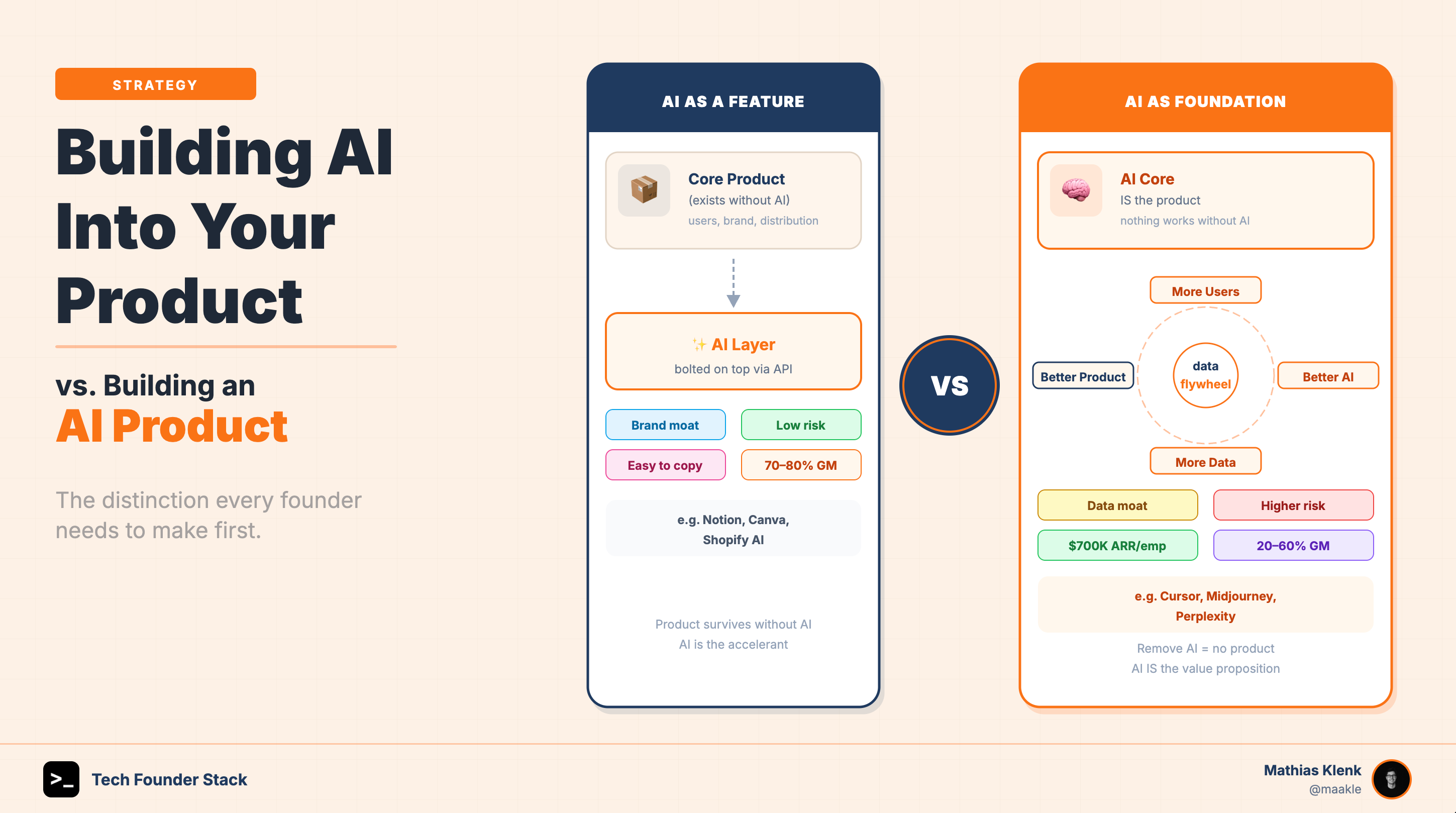
AI-enhanced companies take an existing product or workflow and layer AI on top. Think Canva adding Magic Design to generate templates from text prompts, or Shopify embedding an AI copywriter into its product listings. The core product existed before AI, and it would continue to function (albeit less impressively) if the AI layer were stripped away. The product solves a known problem. AI makes it faster or smarter.
AI-native companies are built from the ground up with AI as the core value proposition. The product simply couldn’t exist without it. Cursor, Midjourney, and Perplexity are textbook examples. Remove the AI and there is no product, just an empty shell. These companies aren’t enhancing a traditional workflow. They’re creating an entirely new one.
Thanks for reading Tech Founder Stack! Subscribe for free to receive new posts and support my work.
This distinction matters because it fundamentally changes your unit economics. Traditional SaaS enjoys gross margins of 70-80% because one more subscriber costs almost nothing. AI-native products, however, pay for compute every time a user sends a prompt or generates an image. Your best users, the power users you’d normally celebrate, become your most expensive users. AI-first SaaS gross margins often run between 20-60%, which is a completely different business. Even OpenAI, with over $13 billion in revenue, reportedly burned $8 billion on compute in 2025. Getting the economics right isn’t optional. It’s existential.
When AI Should Be a Feature
If you already have a product with real users and a clear value proposition, embedding AI as a feature is often the smarter play.
You already have distribution. The hardest part of any startup is getting people to use your product. If you’ve already solved that, adding AI features gives your existing users a reason to stay, upgrade, and pay more. Notion didn’t need AI to be useful. Millions of people already lived inside it. But adding AI summaries, writing assistance, and autofill made the product stickier and justified a price increase. Canva followed a similar playbook, raising its Teams pricing by up to 300% while pointing to AI-powered features as the justification.
Your moat is the product, not the model. When you embed AI, you’re typically calling an external model via API. OpenAI, Anthropic, or an open-source alternative. You don’t need to train your own model or build infrastructure for inference. Your competitive advantage stays where it always was: in your UX, your user data, your integrations, and your brand. The AI is a force multiplier, not the foundation.
You can iterate without betting the farm. Shipping an AI feature is a product decision, not an existential one. If the feature underperforms, you can pull it back, tweak the prompt, swap the model, or try a different approach. You’re not rebuilding the company. You’re improving a feature. This gives you room to experiment, which is exactly what you need when the underlying technology changes every few months.
The risk is obvious though. If AI is just a feature, it’s also easy to copy. Every SaaS company can bolt on a ChatGPT integration. If your AI feature isn’t deeply embedded in your workflow or powered by proprietary data, you’ve built a nice-to-have, not a moat. Bessemer’s State of AI report put it well: features built atop large models commoditize quickly. Each new capability triggers a flurry of copycats.
When AI Should Be the Foundation
On the other side, building an AI-native product is harder, riskier, and potentially far more rewarding.
You’re creating a new category. When Cursor launched, they weren’t adding AI to an existing IDE. They rethought what a code editor should look like when AI is a first-class citizen. When Midjourney appeared, it didn’t enhance Photoshop. It made image generation accessible to people who had never opened a design tool. AI-native products don’t compete with existing solutions on features. They compete on a fundamentally different vision of how work gets done.
The compounding advantage is enormous. AI-native companies build what the industry calls a data flywheel: every user interaction generates data that makes the product better, which attracts more users, which generates more data. This is incredibly hard to replicate from the outside. A traditional SaaS company can add an AI feature, but it can’t easily build the feedback loops and proprietary datasets that an AI-native competitor has been accumulating since day one. I wrote about this same dynamic in my piece on network effects. The compounding loop is the same principle, just applied to data instead of users.
The financial upside reflects the ambition. According to SaaStr’s recent research, the best AI-native startups are achieving $700,000 in ARR per employee. When your product does the work that used to require a services team, your unit economics look completely different. Customers understand they’re paying for outcomes, not seats. And they’ll pay accordingly.
The risk here is equally clear: you’re exposed to model commoditization. If your product is essentially a thin wrapper around GPT-4 or Claude, you have zero defensibility the moment the next model drops. The AI-native companies that survive are the ones building deep domain expertise, proprietary data pipelines, and user experiences that can’t be replicated by prompting a foundation model. If your product can be rebuilt in a weekend with a new API, you don’t have a company. You have a demo.
How to Decide
So which path should you take? In my experience, it comes down to three honest questions.
1. Does your product fundamentally require AI to deliver its core value?
If you’re building a legal research tool that reads thousands of case files and surfaces relevant precedents in seconds, that’s AI-native. The product doesn’t work without the model. But if you’re building a project management tool and you want to add smart task suggestions, that’s AI as a feature. Be honest about this. Calling yourself “AI-native” when you’re really “AI-enhanced” doesn’t fool investors, and it certainly doesn’t fool customers.
2. Where does your defensibility come from?
If your moat is proprietary data, a unique training pipeline, or a novel model architecture, you’re in AI-native territory and you should lean into it. If your moat is distribution, brand, user habits, or network effects, keep AI as a feature and double down on what actually makes you hard to replace. The best companies know where their real advantage lives and invest there.
3. Can you afford the economics?
AI-native products have a fundamentally different cost structure. Every API call, every inference, every generated image costs real money. If you’re bootstrapped or running a lean operation, the compute costs can be brutal. Model this out before you commit. Know your cost per user at P50 and P90 usage levels. If your heaviest users cost you ten times what your average users do, you need a pricing strategy that accounts for that from day one. Not after you’ve already scaled and your margins are underwater.
The Line is Blurrier Than You Think
Many of the best companies start as AI-enhanced and evolve toward AI-native as the technology matures and they accumulate proprietary data. Others start AI-native and realize their real value is in the workflow they’ve built around the model, not the model itself.
The mistake isn’t picking the “wrong” camp. The mistake is not being intentional about which camp you’re in. When you’re unclear about whether AI is your feature or your foundation, you end up with confused hiring priorities, messy architecture, and a pitch that doesn’t resonate with anyone. You over-invest in ML infrastructure you don’t need, or you under-invest in the data flywheel that would actually give you an edge.
As with most things in startups, clarity is a competitive advantage. Know what you’re building. Know why AI is in your product. And know what your company looks like if the AI layer changes, because it will.
The founders who get this right won’t just survive the current wave. They’ll be the ones shaping it.